
🗓️
Jan 5, 2026
Why don't we just 3D-print everything today?
When I chose to study mechanical engineering at university, never did I imagine that I'd be able to design something today and be able to hold it in my hand in a couple of hours. 3D-printing changed the game in terms of bringing ideas to life. Naturally, it raised a more important question: why don't we just 3D-print everything?

The sheer number of hardware startups I've seen in the Bay Area relying on 3D-printing to build prototypes/products is amazing. Everything from complex designs like delivery robots to simpler designs like smart lamps have #D-printed parts.
While 3D-printing has lowered the barrier to fabricating designs, it doesn't necessarily guarantee engineering quality. Understanding why that's not the case requires a deeper dive into this technology.
How does 3D-printing work (and why it matters)?
To understand the limits of 3D-printing, we need to first understand how it works. There are multiple ways to 3D print something, here's what they look like:
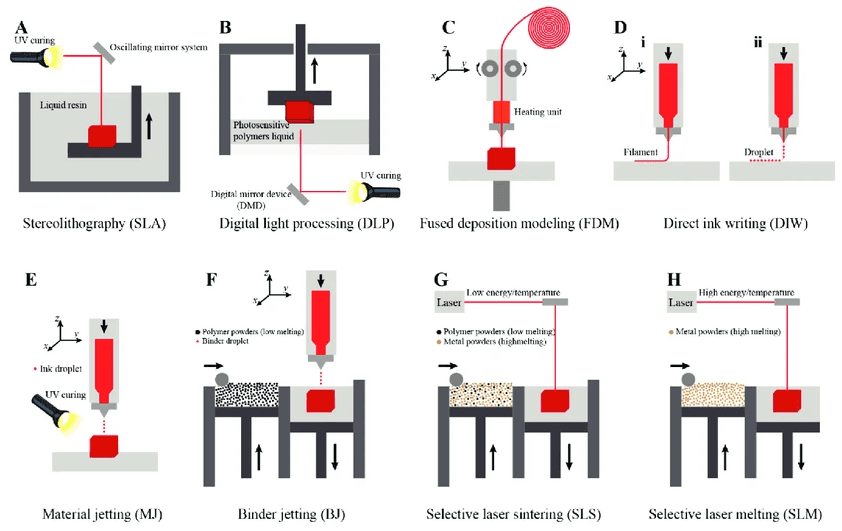
Rather than explaining how every 3D-printing process works, it's more useful to consider the factors that can be used to evaluate each process - underlying technology complexity, materials, cost, and time - to make better design decisions.
These factors reveal a simple truth: 3D-printing is a game of tradeoffs. Here's what I've learnt from my experience working with some of these 3D-printing technologies:
FDM: simple technology (heated nozzle extruding a thermoplastic), large range of materials, low-cost, highly anisotropic structural properties, fast part turnaround times
SLA: complex technology (UV light that causes light-sensitive polymers to harden), smaller range of materials, high-cost, brittle and UV-sensitive parts, slow part turnaround times
SLS: highly complex technology (high-power lasers to fuse powdered material), large range of materials (can support thermoplastics and metals), high-cost, isotropic structural properties and higher fatigue resistance but have high porosity, extremely slow part turnaround times
Materials are a big bottleneck
When designing something to be 3D-printed, materials need to be considered early on in the design process. Although there's a lot of options to tune 3D printer settings to fabricate parts better, overall part performance is mostly constrained by the material that's been chosen to 3D-print it.
ABS filament emits toxic styrene fumes when being used to print, photopolymer resins are a pain to wipe off the print bed, and watching videos of removing powder from SLS parts show just how tedious the process is.
In spite of these drawbacks, I've noticed that some of the companies that develop 3D-printers also invest in expanding their own in-house material offerings like Formlabs:
There's a lot of room for pushing the boundaries of the materials that can be used to 3D-print, and this approach is great for both companies like Formlabs and their customers - the company expands their product suite and their customers benefit from a larger selection of engineering-grade materials to choose from.
Prototyping to Manufacturing
Instead of pushing volume, I built depth. Every time I released something new, I updated existing templates too—improving performance, adding dark mode, refining interactions. This gave buyers a sense that the templates were alive, not static.
Eventually, I bundled them into curated collections: portfolios, landing pages, startup kits, blog-first sites. That’s when sales really took off.
Now that there’s consistent MRR, I’ve automated a lot—delivery emails, license handling, updates. But I still reply to support questions myself, and send personal thank-you notes when someone tags me in their finished build. People remember that.
